Retirement!


Retirement!

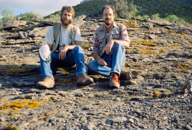
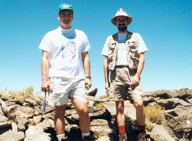
After 33 years here at Carleton University I am retiring on August 31. 2025. In many ways, time has flown by. I have enjoyed every minute at Carleton – wonderful colleagues, an enthusiastic cadre of graduate and undergraduate students interested in igneous rocks and geochemistry, and lots of opportunities to pass on what geologists do to the public who, after all, fund the university. I have been very fortunate to have wonderful mentors and collaborators over the years since I discovered geology while at junior college in Montreal.
My interest in igneous rocks and plate tectonics was inspired by Don Francis, Andrew Hynes, and Reinhard Hesse at McGill University during my undergrad. I also met future University of Ottawa professors Andre Lalonde and Tony Fowler, and future collaborator Brendan Murphy who were PhD students at McGill while I was an undergrad. McGill was fun!
My love of teaching goes back to being a M.Sc. student at UBC. The 1st-year lab coordinator for the Department of Geological Sciences was Carlo Giovanella, who saw that I loved to TA. He would choose me to be a TA for new courses, and was always challenging me. I did my first TV interview while at UBC, doing a segment for the local CTV station on seafloor hydrothermal vents, and discovered that having a TV camera in front of me did not make me nervous. I found out the next day from my mother that the segment made the CTV National News that evening!
My MSc thesis on midocean ridge and seamount basalts from offshore British Columbia worked out just as I wanted, but I was lucky. Along with Dick Chase, my supervisor, I was supposed to go to sea on CFAV Endeavour to look for hydrothermal vents, but the ship went into refit and our cruise was cancelled. So I got to work on seafloor lavas already in the UBC collection, which was what I was interested in. I was also privileged to work with Dick Armstrong, who also was my scuba diving partner when we both took lessons at UBC. After graduation, I was lucky that Steve Calvert and Tom Pedersen in the Oceanography Department were looking for an XRF technician and I fit the bill. I spent a wonderful three years in their lab along with technician Maureen Soon and a great group of graduate students. It also gave me time to do more research on seafloor lavas and I got two papers published from my MSc thesis.
Left: With RV Fisher and students on calderas field course, 1988. Right: Enjoying Christmas Day on Gran Canaria, 1988.
Once I knew that the UBC job was ending, I looked to go back to school for a PhD, preferably looking at ocean island lava chemistry. I picked UC Santa Barbara largely because I got such a great reception from faculty members when I visited the department the summer before I was going to start. I was lucky (again!) that Frank Spera moved from Princeton to Santa Barbara, and he was running a research program on Gran Canaria in the Canary Islands. It was the prefect project for me and was fortunate to have Frank and George Tilton as supervisors. I also worked with John Lupton, who introduced me to helium isotopes and gave a short speech about me at my convocation ceremony in 1990. I am indebted to marine geophysicist Ken Macdonald and his research group for accepting a petrologist into their seminars, hiring me to help in their lab (I sure needed the money!), and taking me on a SeaMARC II research cruise to the Galapagos and East Pacific Rise spreading centers that ended at Easter Island – what a trip!
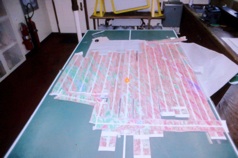
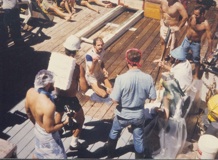
Left: SeaMARC II strip chart map, Galapagos Spreading Center. Right: Participating in the Equator Crossing Ceremony on RV Moana Wave.
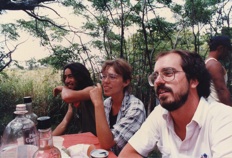
Left: picnic on Easter Island, Suzanne Carbotte on my right. Notice that I used to have lots of hair...
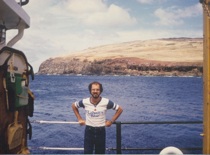
Right: On the Moana Wave, offshore oa Rano Kau volcano, Easter Island.
I met Jamie Allan not long after I left UBC, where he was doing a post-doc with Dick Chase. Jamie made the trip down to UCSB so that we could do isotope work on seafloor lavas from the Tuzo Wilson Volcanic Field and other locations offshore of British Columbia. Jamie and I became good friends. While at TAMU/ODP, he roped me in as a shore-based scientist for ODP drilling in the Japan Sea. Jamie then came to Lake Tahoe during my first field season there to help with field work and later did many mineral analyses that went into a 2008 paper on the volcanism in the Tahoe area. When Jamie moved to Appalachian State University, I drove down to Boone for a few days so that we could plan out mutual research projects, but Jamie moved to NSF in Washington DC before we could get any projects going. We continued to meet almost every year at the AGU meeting in San Francisco, including going Christmas shopping for our wives and family!
After my PhD from UC Santa Barbara, I moved to Ottawa, and was a soft-money researcher and contract instructor for 15 years. This was a lot of fun, working with many geologists across Canada, the western US, and elsewhere, plus helping grad students at Carleton and the University of Ottawa with their isotope work. Kudos to Keith Bell and John Blenkinsop for giving me complete freedom in the isotope lab at Carleton and to Keiko Hattori for arranging contract instructor opportunities at uOttawa. I have also been very lucky to have been part of a supportive Earth Sciences department at Carleton including all the faculty and staff over the last 33 years.
Left: Jarda Dostal (center) with Wulf Mueller (left) and Brendan Murphy (right). Right: Jim Franklin from his LinkedIn page. I was honoured to attend his induction into the Canadian Mining Hall of Fame in 2019, but have lost a wonderful photo of him that I took after the ceremony.
Two of my major supporters when I returned to Canada were Jarda Dostal and Jim Franklin. Jarda flew me to Halifax on several occasions, introduced me to other Atlantic geologists including Brendan Murphy, and involved me in research projects in Atlantic Canada and on the West Coast (with Tark Hamilton). He also got me involved in the Volcanology and Igneous Petrology Division of the Geological Association of Canada. Jarda has been an inspiration to me. Jim Franklin, while at the Geological Survey of Canada, organized a terrific PDF project on the hydrothermal vent deposits and other rocks recovered during ODP drilling at Middle Valley on the Juan de Fuca Ridge. Jim was also a common isotope client after he left the GSC and became a mining consultant.
My own research went in three directions – greenstone belts in the NWT and Nunavut, modern seafloor and ocean island volcanism, and continental arc/extension igneous activity in eastern California and northern Nevada. I met Hendrik Falck in my second summer in Yellowknife, leading to a number of collaborative projects in the southern Slave Province, contributions to the Yellowknife EXTECH project, and later to research in the Selwyn Basin. I always remember Hendrik’s advice about finding a group of collaborators who “play well together”. He and other geologists in Yellowknife certainly fit that mold and made my geochemical research extremely enjoyable. The NWT research led to similar work in Nunavut through the Western Churchill NATMAP project guided by Simon Hanmer and Carolyn Relf. I was working with two other soft-money geologists, Larry Aspler and Jeff Chiarenzelli, both based in Ottawa and ex-grad students of Al Donaldson (note that Hendrik was also a Donaldson student – is there a theme here?). Larry and Jeff were super fun to work with, and I believe that we got the first journal article from that NATMAP published in Geology. One great memory was Jeff hoisting me on his shoulders to wade me out to the float plane that was taking me home, since the plane could not come all the way into shore at our camp. It was nice to have dry feet for the trip home!
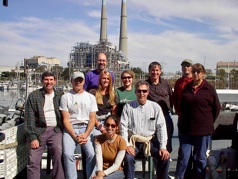
Left: Hendrik Falck (right) with my grad student Thomas Mumford doing field work in the south Slave province. Right: The 2003 science party for the MBARI seamounts cruise. Dave Clague in on the left.
I had known Dave Clague (then at the USGS) for several years, and he then moved to the Monterey Bay Aquarium Research Institute. We met again over lunch at AGU in 2000, and he complained that he was waiting a long time to get radiogenic isotope data from the lab he was using. I volunteered to do isotope work for him, and this led to me and Carleton students being invited on several MBARI research cruises to Hawaii and the Juan de Fuca Ridge. I was very impressed with what ROV’s could do, especially on a ship specially built for that task, and how Dave developed special sampling methods for seafloor research. The Hawaii cruise led to an extensive study of subaerial and submarine shield, postshield, and rejuvenated stage lavas from Kauai and Niihau that took five years to finish – thanks Dave for being so patient.
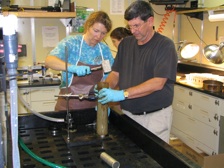
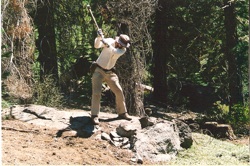
Left: Jenny Paduan and Dave Clague extruding a sediment core on the RV Western Flyer. All the MBARI cruises were fun! Right: Chris Henry (Nevada Bureau of Mines and Geology) collecting a rock sample for geochronology from the Lake Tahoe area.
While at grad school at UC Santa Barbara, I went on lots of field trips to Arizona and California – to the desert in winter and to the Sierra Nevada in summer – and loved the superbly-exposed geology of the US southwest. After moving back to Canada, I had a chance to do some field work around Long Valley Caldera in 1992 and in 1993, looking at the mafic to intermediate lavas rather than the “sexy” high-silica rhyolites and ignimbrites that were already well-studied. This was the stepping stone to the start of a 28-year long study of continental arc volcanism in the southwestern US that pre-dates the modern Cascade Arc. Bill Wise and Art Sylvester from UCSB got me started working around Lake Tahoe, giving me copies of their brand-new geology maps from the north side of the lake. Then in 2000, I met Chris Henry of the Nevada Bureau of Mines and Geology at a NAGT conference in Blairsden, California. Since that lucky introduction, Chris and I, along with students from Carleton, have slowly progressed eastwards from the Lake Tahoe region east across the Cenozoic volcanic arc exposed in northern Nevada. This has been the most satisfying part of my research career, where we combined detailed mapping, Ar-Ar and U-Pb dating, and whole-rock geochemistry and radiogenic isotope analysis to evaluate the petrogenesis of lava flow complexes and caldera ignimbrites, lavas and intrusions that range in age from Eocene to late Pliocene. Unlike the modern Cascade Arc, the older continental arc derives mafic magmas from metasomatized lithospheric mantle during Farallon slab rollback, something that was totally unexpected at the outset of the project. Our last bit of field work was in May 2023, and now that our isotope clean lab renovation has finally come to an end (two years shutdown!) I can run the last rocks to tidy up the story.
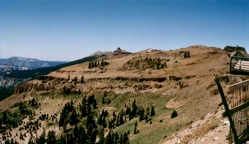
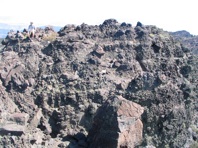
Right: The view of volcaniclastic deposits and lavas north of the Squaw Valley USA ski resort, Lake Tahoe. Right: Grad student Albert Stoffers sitting on thick volcaniclastic deposits north of Lake Tahoe.
My students and I stayed in a number of accommodations in Nevada over the years. Chris Henry was a wonderful host on many occasions. There were three motels that we especially liked: the Big Chief Motel in Battle Mountain, the Cozy Mountain motel in Austin, and Middlegate Station on Highway 50. I used the Big Chief and the Cozy Mountain as bases for both field work and Carleton field courses to northern Nevada, and I thank the owners (especially Cindy at the Cozy Mountain) and staff for making our stays comfortable! If you travel to Battle Mountain, be sure to eat at El Aguila Real restaurant – superb Mexican food. Middlegate Station, population 17, was a perfect base for our work in north central Nevada. “Rustic” is a great term to describe the hotel and bar - it is worth the stop for the décor, a Monster Burger and a cold beer - the people there are terrific and the food is excellent. Can’t ask for more.
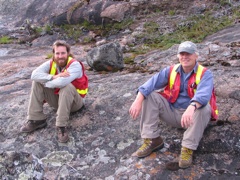
Left: With Bruce Pauly (left) and Chris Henry at Upsal Hogback volcano in 2006. Right: With graduate student Erika Anderson standing on a dike at Ship Rock, New Mexico.
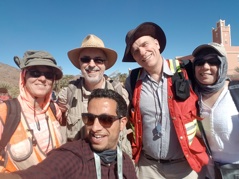
Teaching was always a passion of mine, especially teaching field courses. Students learn more in the field in two weeks than they do in three months in a classroom! Tim Patterson and I did several trips to the southwestern US, and I led three trips to Hawaii and four trips to Iceland. But the most memorable trip was to Morocco in 2018, including 26 students and geologists Richard Ernst, Hafida El Bilali, Said Belkacim and Yvette Kuiper. The trip was primarily organized by my colleague Moha Ikenne (Université Ibn Zohr, Agadir) and included a day in the CAMP province led by Nasrrddine Youbi (Université Cadi Ayyad, Marrakech). This was the first Carleton Earth Sciences field course to Africa. Moha made sure that we experienced Moroccan culture as well as geology, and even arranged a camel ride into the Merzouga dunes for us!
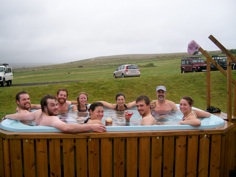
Left: In Morocco in 2018; Yvette Kuiper, Me, Richard Ernst, Hafida El-Bilali and Said Belkacim in front. Right: Students and me enjoying the hot tub on the Iceland field course in 2009.
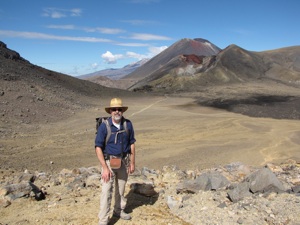
Left: At the Hula Grill in Kaanapali in 1996, taking a break during our Carleton field course to Hawaii. Right: On the Tongariro Alpine crossing, New Zealand, 2014.
None of this could have happened without enthusiastic students at Carleton, like Ann Timmermans, Albert Stoffers, Thomas Mumford, Matt Trenkler, Erika Anderson, Liz Cornejo, Nicole Williamson, and many others who have done superb work. Julie Prytulak, one of my first undergrad students who took on a BSc thesis study around Lake Tahoe, has just taken up a CRC position at UBC which means I may get to see her more often. Over the last few years, I have co-supervised a number of grad students with Richard Ernst and have enjoyed being part of his LIPs research group. I have also been lucky to have some terrific Visiting Scientists, such as Nadia Mohammadi, who came to Carleton to learn all they could about radiogenic isotopes in our facilities. I have loved having students and researchers visit Carleton to do their own chemistry and learn the ins and outs of mass spectrometry.
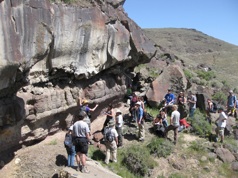
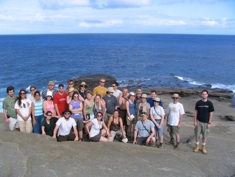
Left: Teaching at the Buffalo Valley volcanic field, central Nevada, 2015. Tight: The group on the 2008 Hawaii field course at Lanai Lookout, Oahu.
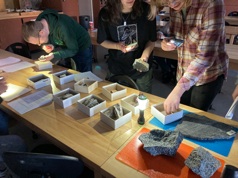
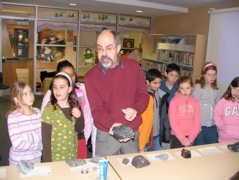
Left: teaching an igneous petrology lab during a power outage, 2025. Right: Doing a rock and minerals show for elementary school kids in 2003.
Most of all, thanks to my wife Caroline and my daughter Kristen for both tolerating my love of volcanoes and geology and for sometimes participating in it! Now I hope that I can get my grandkids to see why Grampy loves what he does.
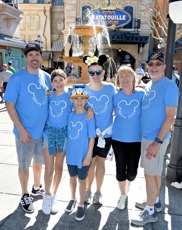
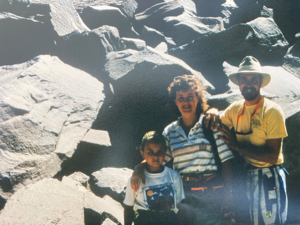
Left: At Disney World in 2023 with Caroline and Kristen’s family. Family times are the best of times! Right: Caroline and Kristen with me at the Devils’s Postpile, California, in 1992, while doing field work at Long Valley caldera.
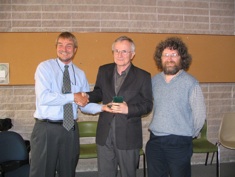
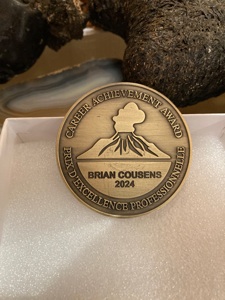
Finally, thanks to the Volcanology and Igneous Petrology Division of the Geological Association of Canada for this award, and special thanks to my nominators Nadia Mohammadi, Hendrik Falck, Richard Ernst, Hafida El Bilali, and Ann Timmermans
The early days!
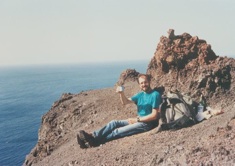
Upper left: with Jamie Allan at Squaw Peak, Lake Tahoe area, 1997.
Lower left: With Michael Ort on Gran Canaria, 1988.
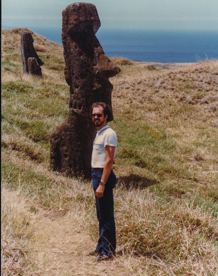
Right: In 1987 on Easter Island, taking in the moai at Rano Raraku quarry.